

A steep Hills block as we find it, and the kind of garden we build on one: dry sandstone walls and steps, grasses and salvias, and lights set into the risers.
Steep blocks, stepped and planted.
Pegged out. String lines at every level, and the falls marked.
Take the string and pull it down the block.Drag the peg down, or tap Build it.
We design gardens for the steep blocks of the Adelaide Hills and the foothills, and build them: walls and steps in sandstone, the planting, a little water and the lights. One small crew from Aldgate, from string line to first mow.
Steep is the brief.
We walk it top to bottom and back before we draw a line: where the storm water runs when it really rains, whether it’s clay or rock a spade down, where the frost sits at the bottom, and where February’s north-westerly comes over the ridge.
A slope wants to move. Our job is to hold it: a wall where the level changes most, a planted batter where it changes least, and every drain sent somewhere it can go.
Steps are the part you use every day, so we set them with one rise from top to bottom. By the third step your feet stop thinking about it.
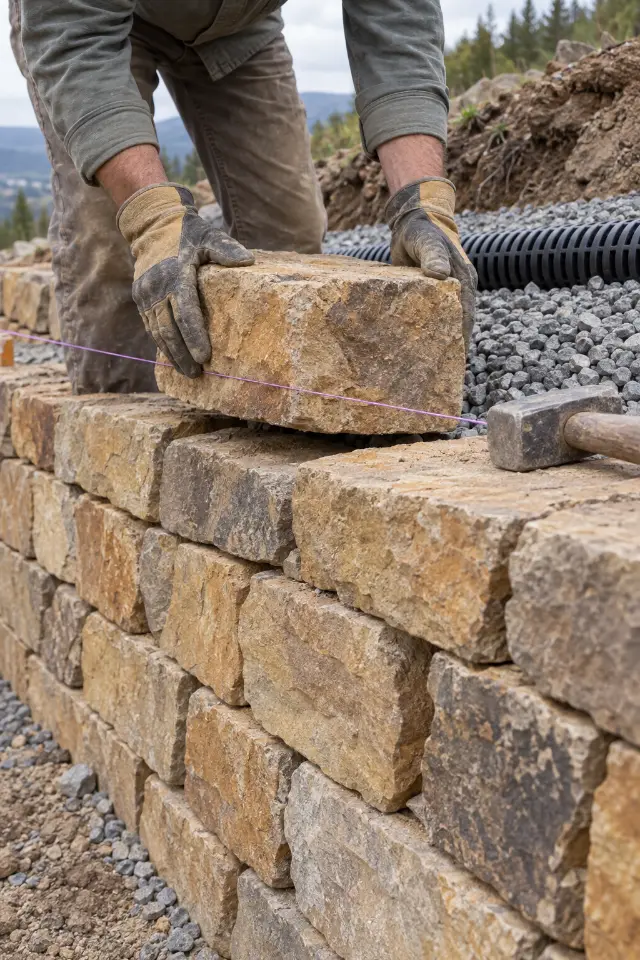
Stone the colour of the hill.
We choose sandstone that matches the ground it sits in, so a wall looks settled the week it’s finished.
We lay it dry. Water gets through, and the wall moves with the clay instead of cracking. Gravel and a slotted pipe go in behind, because on a slope the water is always coming.
A low wall leans back into the bank and holds itself. A taller one, or one with a driveway above it, gets an engineer’s drawing before we cut.
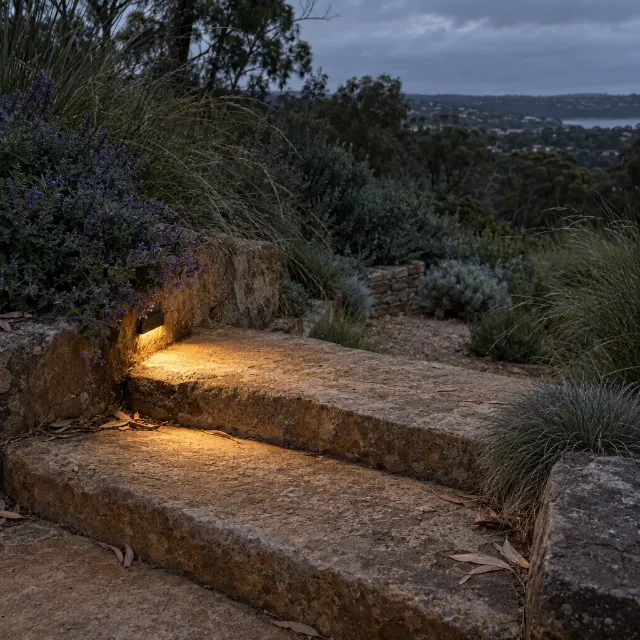
Steps go in the same stone, with treads deep enough for a bucket in each hand.
String line to first mow.
We walk the block with you and mark where the water runs, draw the plan at your kitchen table, peg it out with string at every level, cut the terraces and keep the good topsoil aside, lay the walls from the lowest up with gravel and a pipe behind, set the steps, fill the beds, plant in autumn while the ground’s still warm, light the steps, water it all in through the first summer, and come back to cut it back the first autumn, which is when we hand it over.
Planted, not placed.
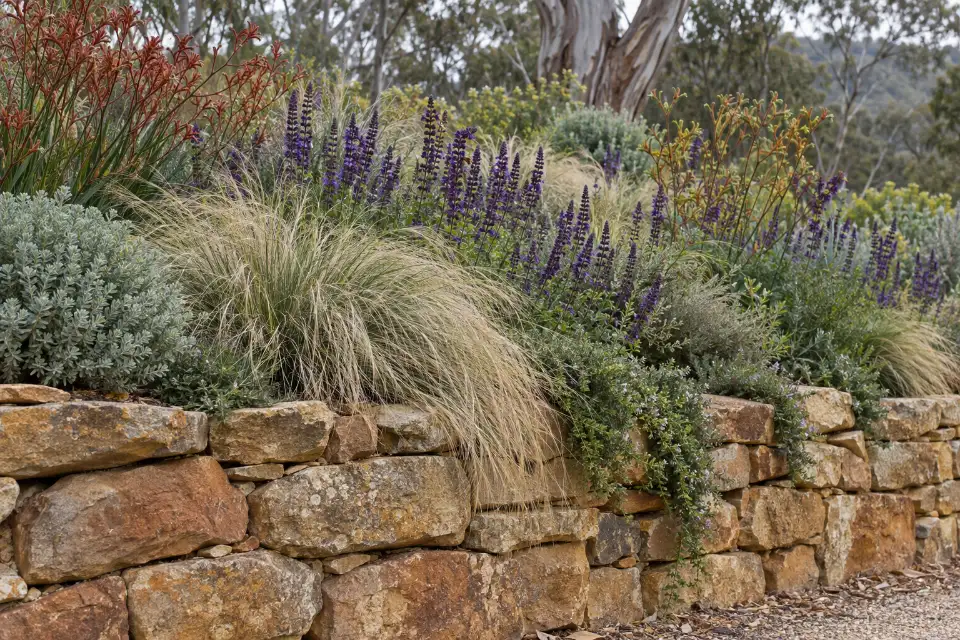
What grows on a Hills slope through a dry February: poa and lomandra that go straw-coloured and don’t mind, salvias the bees find in a day, kangaroo paw, westringia and correa. We plant in drifts, at the spacing each plant wants when grown.
- 22 poa tussock at 400 mm
- 10 salvia at 600 mm
- 4 kangaroo paw at 600 mm
- 3 westringia at 1.2 m
- 1 correa at 1.2 m
Choose a plant, then brush a drift across the bed.
40 plants over 10.5 m² of a 14.5 m² bed: 22 poa, 10 salvia, 4 kangaroo paw, 3 westringia, 1 correa. Illustrative, drawn for this page.
Seventy-five millimetres of mulch, a drip line under it, and the first summer is ours to water.
Lights for the steps, not the sky.
Fittings sit low, warm and shielded, set into the riser, so you see the tread and not the lamp. They run on a timer, and nothing is aimed up into the gums.
They go in with the steps, not after. Water stays small: a stone bowl by the path where the birds find it, or a short rill you can hear from the steps.
We stay till the first cut-back.
Through the first summer we come back to water, and to check the walls after the first big rain.
Stakes come out once the roots hold.
In autumn we cut the grasses back to a fist and the salvias to their new growth, and show you how, so the second autumn is yours.
You keep a note of what we planted where, drawn the way the bed above is drawn.
Where we build.
- Crafers
- Stirling
- Aldgatewe draw here
- Bridgewater
- Hahndorf
- Mount Barker
- Burnside
- Mitcham
Designed from Aldgate; built between Crafers and Mount Barker, and down the face into Burnside and Mitcham.
Walk the block with us.
Tell us where it is and how it falls. We’ll come up, walk it with you and bring the string.