
We’re 1.0 km north of the launch paddock now.
Down in the paddock. Kettle’s on.
Up with the light. Down for breakfast.
Hot-air balloon flights at first light over the farmland east of Mount Barker. About an hour in the air for a small group, then breakfast where we land. We go only when the morning is right.
Dawn flights over the farmland east of Mount Barker: about an hour up with a small group, then breakfast where we land.
- Alt
- 0 m
- Vario
- 0.0 m/s
- Envelope
- 78 °C
- Ground
- 0.0 km/h
- Heading
- 000° N
The instruments read live while the flight runs.
Wind and flight model illustrative. Not a forecast.
Pilot flying
Hold Burn to climb; let go and the air cools. Low down the wind comes from the south, and above the warm layer it swings round from the north-west. Height is the only steering we have.
The air is quiet until the sun wakes it.
Overnight the ground gives up the day’s warmth, and the air lying on it goes cold and still. A warmer layer settles over the top like a lid. Under the lid the breeze is light and usually comes from the south. Above it the wind often turns and comes from the north-west, and that turn is how we steer: we choose a height to choose a wind.
By mid-morning the sun has warmed the paddocks and the air starts to rise off them in thermals. Good for hawks, no good for us. So we meet in the dark and fly as the light comes.
The sun is our deadline.
Temperature and wind by height

Some mornings we don’t fly.
We make the call twice: the evening before, and again at the paddock before first light. There we let a small helium balloon go and watch how fast it drifts, and which way. Then we look at the wind low and high, cloud on the hills, fog in the gullies, showers about and any front on its way.
When we stand down we tell you why, in plain words, and find you another morning. It is always the right call to make on the ground.
How we decide. Tap whatever you can see this morning.
The call
We fly.
Nothing on the board. The envelope comes off the trailer.
How the morning goes.
Every time here is counted in minutes from sunrise, because on the day the sun sets the clock, not the watch.
- −60
Meet in the dark
At a farm gate with torches and a flask of coffee. The briefing, the wind check, the little helium balloon let go, and the call.
- −25
Cold air, then heat
A fan fills the envelope with cold air as it lies on the grass. Then the burner warms it and it stands up over the basket. You climb in.
- 0
Up with the sun
We lift off as the first light reaches the paddock, and rise through the cold air into the still layer above it.
- +60
Down in a paddock
About an hour later we come down wherever the wind and the farmer allow. Knees soft, handles held, until the basket settles.
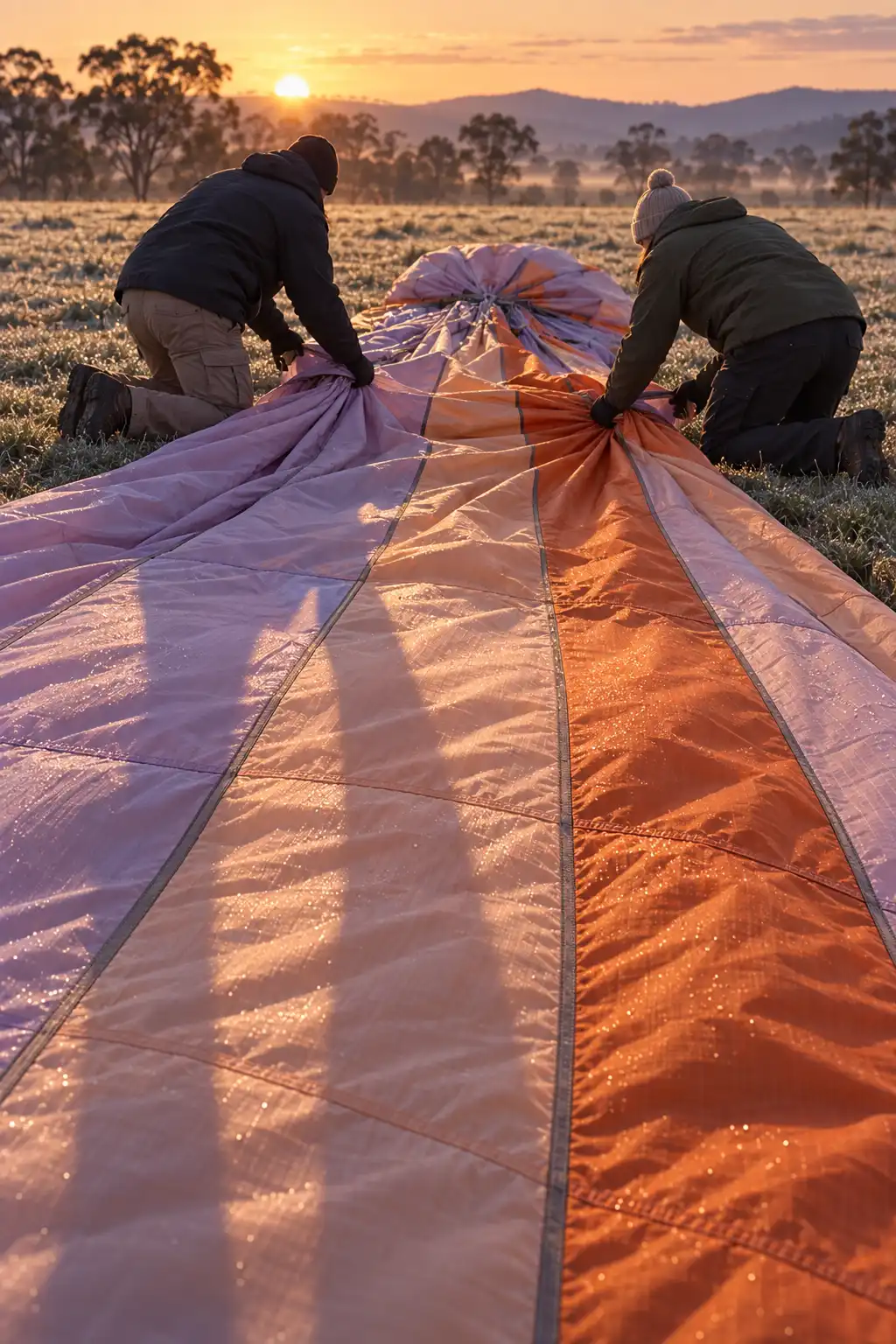 +75
Everyone folds the envelope
Many hands, one long bundle, back into its bag.

Times move with the season; sunrise sets the clock.
East of Mount Barker, wherever the wind says.
Below us are farmland and low hills: cropping paddocks and lucerne, sheep, dams, and creek lines with river red gums. We launch from paddocks arranged with the farmers, chosen for that morning’s wind, and we land where it’s kind to the ground and the stock.
No two flights draw the same line. The map shows the one you flew at the top of this page, beside a pilot’s line for a morning like it: low and north first, then up into the north-westerly and back.


Dress for a cold paddock and a warm burner.
Wear layers. The grass is cold and wet before sunrise, and the burner is warm overhead. Flat, closed shoes, a hat or a cap, and nothing loose. You stand for the hour in a divided wicker basket with a small group, and you climb in and out over a waist-high wall.
Everyone who flies is an adult. At the briefing the pilot talks you through the landing: knees soft, hold the handles, stay in until we say.
Bring
- Layers you can take off
- Flat, closed shoes
- A hat or a cap
- Gloves in winter
- A camera on a wrist strap
Leave in the car
- Bags and umbrellas
- Loose scarves
- Anything you’d mind dropping into a paddock

Breakfast goes where we land.
Wherever we come down, the trestle goes up.
When the farmer is happy for it, we set up a trestle table in the paddock. When the grass is wet or the wind has come up, we go to a farmhouse kitchen nearby instead.
Tea, coffee and juice, bread, eggs, fruit and something warm from the oven. You’re back at your car by mid-morning with the whole day still ahead.
We pack first, then eat. The kettle goes on while we fold.
A parhelion is the bright spot beside the sun.
On a cold, clear morning, ice crystals in high cloud can bend the low sun’s light into a patch of colour 22 degrees to one side of it, and sometimes one on each side. They’re called sun dogs. Pilots see them from the basket on still winter mornings.
We took the name because they only show up early, when the air is quiet.

Ask for a morning.
Tell us the weeks that suit and how many of you there are. We’ll come back with mornings to hold, and keep in touch as the weather shapes up.
We confirm mornings a day or two ahead, and again the evening before.