
The sun’s path today, laid flat on the lawn. North is toward you.
Every roof has its own noon.
We design and install rooftop solar and home batteries in Mitcham, Belair and the southern foothills, and we draw each system to the one roof it sits on: its pitch, which way it faces, the chimney and the neighbour’s gum, then the way your house uses power through the day.
Drag the sun along its arch, or press Play the day. Tap a panel on the roof for its share of the day.
The sun 24 October
Arrow keys move the sun ten minutes, Shift and an arrow an hour, Home and End to the dark at either end, Page Up and Page Down a month.
The sun is 43° up, 71° east of north. The chimney has the east end of the top row until about 10:30 am.
What the roof makes
0.0 kW right now
What that runs so far today
- 0hours of the split system
- 0loads of washing
- 0km in an electric car
- 0days of the fridge
Typical use: split system 1.5 kW, washing 1 kWh a load, car 15 kWh per 100 km, fridge 1.2 kWh a day. Worked out here for this roof on a clear day.
What shades what, and when.
The north face of this roof pitches at 22.5° and turns eleven degrees west of north. The chimney takes the east end of the top row on spring and summer mornings. The gum next door, taller than the ridge, reaches the west hip on winter afternoons.
So we don’t fill the roof. We put panels where the sun lands and leave the rest bare.
- Pitch, measured, not guessed.
- Which way each face points.
- What shades it, and at what hour.
- Where the cable can run.

The roof in plan, north up. The darker the roof, the more of its light shade takes over a year.
Drawn to your roof.
Move the panel groups and see where shade falls across a whole year. The drawing checks every daylight hour of a typical year, about four thousand four hundred positions of the sun, against this roof.
Across a clear-sky year, shade takes 8.4% of this array’s light. Group B, at the west end of the north face, loses most (11.9%), to the gum, on afternoons after two, worst in March and September. Trimmed, it’s 7.5%. Worked out on this page for the roof drawn here, not a quote.
Checked 4,186 positions of the sun across the year.
Trimmed: the model with the gum’s lower west limbs lifted, to show what it would change. Whether a tree can be trimmed is between you, your neighbour and the council.
On your roof we measure this on site, at the hour it matters.
Drag a group across the roof, or pick one and move it with the arrow keys.
The run you won’t see.
The cable is clipped to the timbers, clear of the downlights and the insulation, and labelled at each end. It comes down one route, which we draw before we lift a sheet. The isolators go where you can reach them.
- Clipped to the rafter, never laid in the batts.
- One route, drawn first.
- Isolation where the rules put it, and where you can reach it.

Your day.
A roof makes most of its power between ten and three. A house uses most of it before eight and after five. This room is about closing that gap.
Reserve at 8:05 pm · 9.7 kWh from the grid
At 7:40 pm the house draws 4.8 kW, the battery gives 4.8 kW. The battery is 40% full.
On 24 October this household uses 25.8 kWh. The roof makes 41.5 kWh on a clear day; 8.6 kWh runs the house as it’s made, the battery is full by 11:25 am, hands back 7.6 kWh and reaches its reserve at 8:05 pm; 9.7 kWh comes from the grid, 24.5 kWh goes to it. Worked out minute by minute on this page for an illustrative household.
Yellow is the roof, cream is the battery, the hatched band is the grid. Drag the dishwasher, the washing and the car to other hours, or use the arrow keys; the sun on the floor reads any minute.
We size a battery from a day like this one, drawn with you at the kitchen table.
The battery lives on the cool wall.
We size it to your evening, not to the biggest box on the truck.
Whether a battery keeps the lights on when the street goes dark depends on how it’s wired in. We’ll tell you plainly which kind yours is, and we set aside a reserve you choose.
- A south wall, out of the afternoon sun.
- Off the floor, clear of the car door’s swing.
- Room either side to breathe.
- A reserve you choose.

We stay on afterwards.
We keep reading each system after we’ve gone. Usually it’s a leaf-choked corner, a loose plug, or a tree that’s grown into the afternoon.

- Monday
- Tuesday
- Wednesday
- Thursday
- Friday
- Saturday
- Sunday
When a panel falls behind the ones beside it, we see it in the monitoring before you do, and we come round. Drawn for this page.
Survey at nine. Handover at dusk.
A job with us runs like one day on the roof, whatever the calendar says.
Survey, in the morning
We come up and measure the pitch, take each face’s aspect, walk the shade and open the meter box.
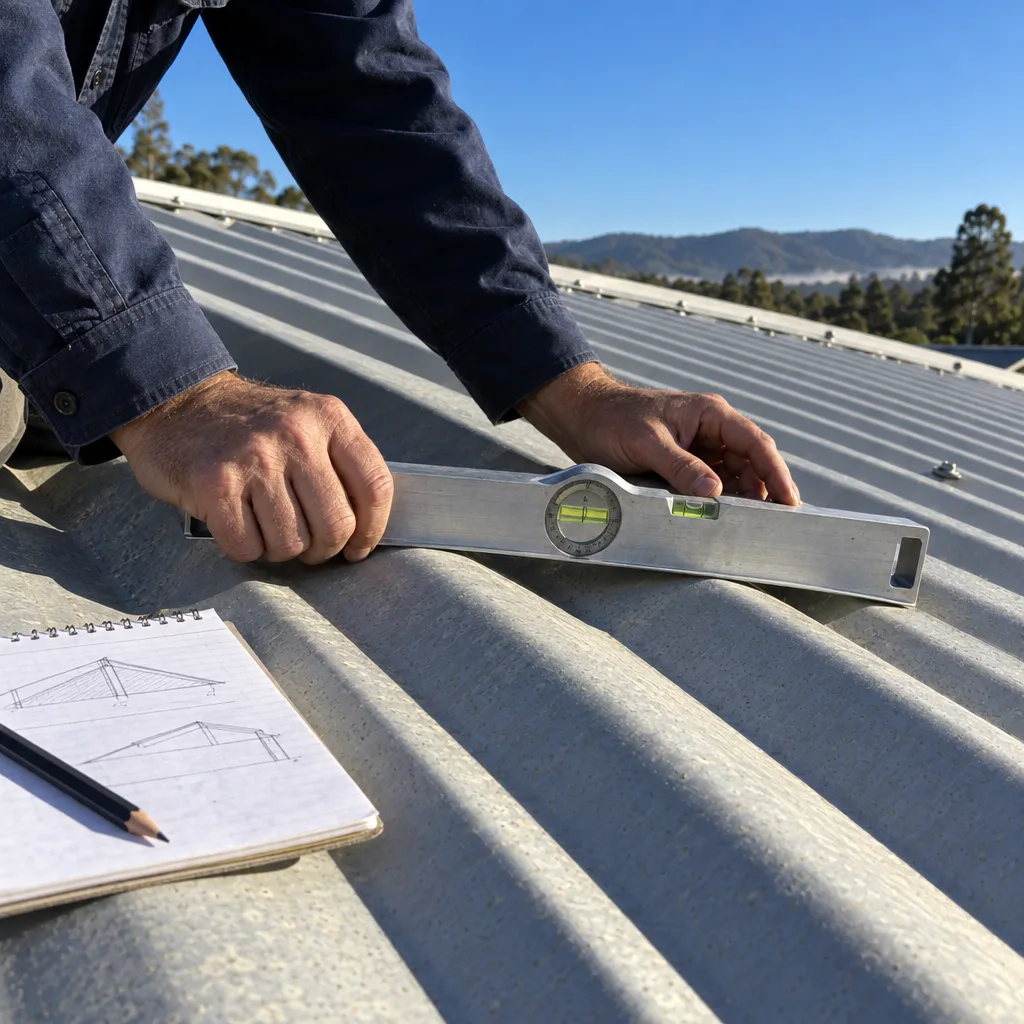
Detail · the survey Design, at noon
We draw the roof and your day, and you see the drawing before anything is ordered.
Install, in the afternoon
Usually a day or two on the roof. The run goes through the ceiling, and the roof is left as we found it.
Handover, at dusk
We show the house its own system: where the isolators are, what the monitoring shows, what the reserve is set to.

Ask us round.
Steep blocks, old stone and big gums: no two roofs up here face quite the same way. Tell us about yours and we’ll come and look at the hour it matters.