
Ingate: the channel the metal runs through into the mould.
A bronze foundry in Lonsdale. We cast sculpture for artists and for gardens, from the first mould to the day the piece is bolted to its plinth.
Drag the crucible down to pour. Pour steadily: metal that slows in the runner cools before the mould is full.
Ingate
Heat 1
Pouring now
No letters full yet
1,180 °C at the gate
Misrun. The metal froze in the runner before the mould filled. We’d break this one out and pour again.
Temperatures from the pour on this page, illustrative. Time is shortened.
Heat 1
Held Stone
Bronze, drawn for this page. Drag to walk round it.
Invested
First the wax is dressed, gated and dipped.
The hollow wax from the mould of your model is checked against the model and its seams cleaned in wax. We attach the gating: sprues, gates and a pouring cup, the channels that let the metal in and the air out. Coat after coat of ceramic slurry and sand builds a shell that can hold molten bronze. In the kiln the wax runs out: the lost wax.
The artist decides
Which surfaces must not be touched. Where the seams may fall. Whether you come in to see the wax before it is dipped.
The foundry decides
Where the gates attach, in places you won’t mind us working afterwards. How thick the shell is. When it goes into the kiln.
Held Stone
Wax in a ceramic shell, with its sprues
Done by the foundry, with you at the wax
One to two weeks of coats, as a guide

Poured and broken out
Then the metal, then the hammer.
The shell comes out of the kiln hot, and the crucible out of the furnace. The pour is one steady movement: stop, and the metal starts to freeze in the runner. Once cool, the shell is broken and blasted away and the sprues cut; a large piece cast in sections is welded back into one.
The artist decides
Whether you want to be here on the day of the pour. How the sections should meet.
The foundry decides
The pour temperature, its speed, the order of the moulds. Where to cut.
Your heat
The foundry’s pour, at the top of this page
Six of six letters full
Temperatures illustrative
Held Stone
Raw bronze, sprues cut to stubs
A day to pour, days to break out and weld, as a guide
Chased
The joins disappear into your surface.
Weld lines and sprue stubs are ground back, then worked with punches, chisels and files until they read as your own texture. The thumbprints and tool lines from the model stay where they were.
The artist decides
Which marks stay. Signing off the chased metal before any colour goes on.
The foundry decides
The tools. How a seam is worked back into the texture around it.

Patina
The colour is yours. The chemistry is ours.
Patina is heat and a brush. We warm the bronze with a torch and lay on thin coats: ferric nitrate for the browns, cupric nitrate for the greens, liver of sulphur for black, or nothing but wax to keep the metal bright. It settles where the form turns inward and is worked back on the high points, so the shape reads from across a garden.
The artist decides
The colour, from test offcuts. Whether the high points shine.
The foundry decides
The heat, the coats and when to stop. The wax, and how it is buffed.

Installed
Bolted down where it will stand.
We visit the site before the pour, so the fixings can be cast into the base: a footing, threaded stainless rod set into the bronze, a plinth of stone or concrete. It is lifted by hand, gantry or crane as the site allows. On the day it is bolted down it gets its first wax where it stands; after that, a wax once or twice a year keeps the colour.
The artist decides
Where it faces. How it meets the ground. The height of the plinth.
The foundry decides
The footing, the fixings and the lift.
- Bronze, drilled and tapped
- Threaded stainless rod
- Stone plinth
- Concrete footing, below the ground line
Where you stand Seen from the north-west
The lost-wax process
From the artist’s model
Nine stages, in the order the metal meets them. Open any one.
-
What we decide. Where the mould is split and how many pieces it takes. How thick the rubber is laid over fine detail.
What you decide. Whether the model can take the release agent and the handling. Whether the mould is kept after the edition.
Time, as a guide: about a week for a piece under a metre.
-
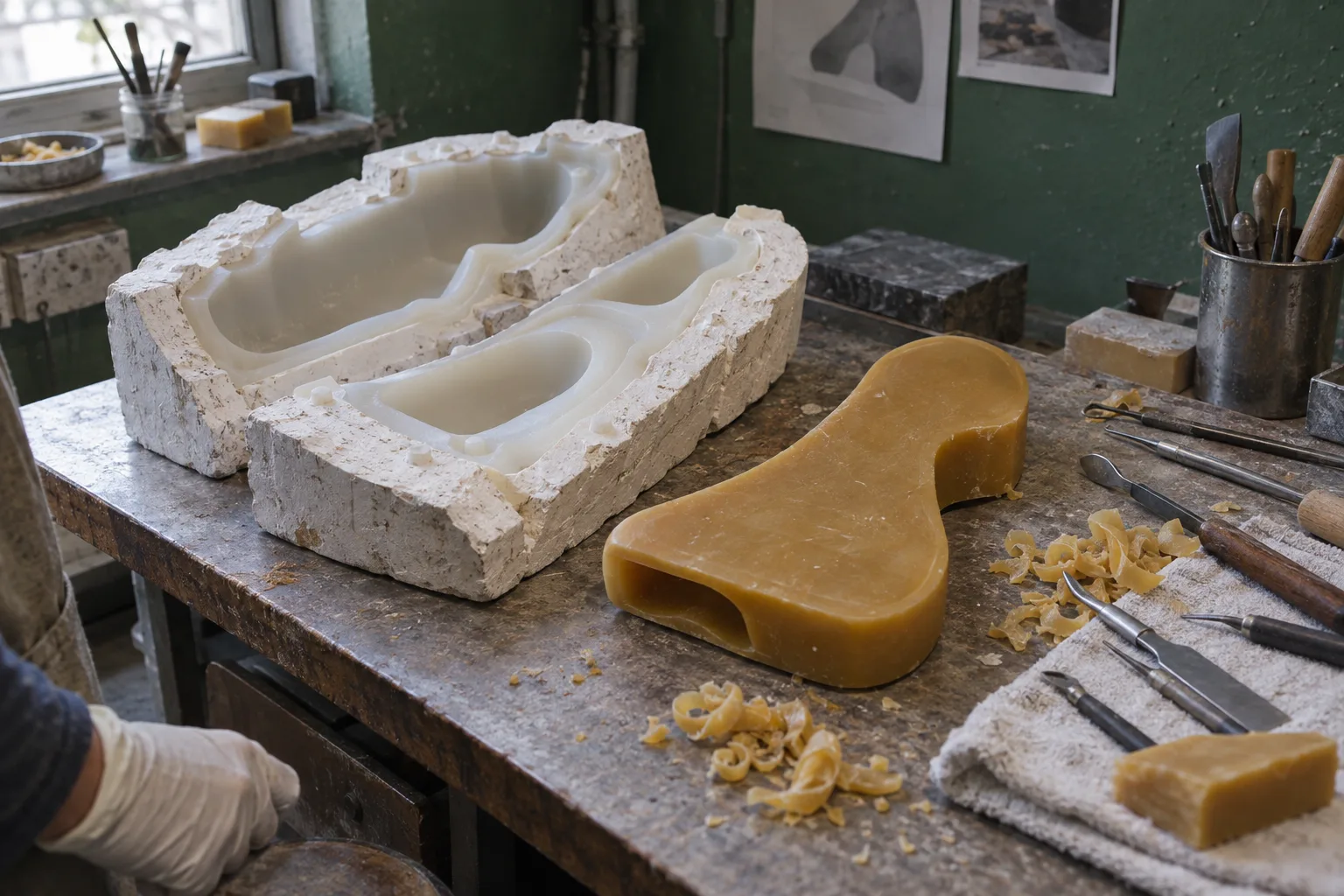
What we decide. The wax and its wall, poured and rolled round the inside of the mould. Where the seams are cleaned.
What you decide. Whether you come in and work the wax yourself. When the wax is right.
Time, as a guide: a few days, and your own time at the wax.
-
What we decide. Where the sprues, gates and cup attach. How many coats of slurry and sand the shell takes, and how each one dries.
What you decide. Which surfaces must not carry a gate. Whether you see the wax once it is gated.
Time, as a guide: one to two weeks of coats.
-
What we decide. The kiln’s heat and how long the shell stays in. Whether a shell is sound enough to pour.
What you decide. Nothing at the kiln. We tell you the day of the pour, so you can decide whether to come.
Time, as a guide: a day in the kiln.
-
What we decide. The pour temperature, its speed and the order of the moulds. Who is on the shank.
What you decide. Whether you want to be here on the day. Which heat your piece goes in, if a date matters to you.
Time, as a guide: a day, with the cooling.
-
What we decide. How the shell is broken and blasted away, and where the sprues are cut. How the sections are welded back into one.
What you decide. How the sections should meet. Whether you see the raw casting before it is chased.
Time, as a guide: days to a couple of weeks, by the number of sections.
-
What we decide. The punches, chisels and files for each seam. How far a weld is worked back into the texture around it.
What you decide. Which marks from the model stay. When the chased metal is signed off.
Time, as a guide: one to three weeks.
-
What we decide. The chemistry, the heat of the metal and the number of coats. When to stop.
What you decide. The colour, from offcuts of the same pour. Whether the high points are left to shine.
Time, as a guide: a day or two, then the wax.
-
What we decide. The footing, the stainless fixings and how the piece is lifted. Its first wax where it stands.
What you decide. Where it faces and how it meets the ground. The plinth: its stone, its height and its finish.
Time, as a guide: a day on site, once the footing has cured.

Who decides what
The piece is yours at every stage. This is how the work divides between us.
The artist decides
- The edition, and how many
- Where the joins may fall
- Which marks from the model stay
- The patina colour, from test offcuts
- Whether the high points shine
- Where it faces
- The plinth: stone, height, finish
- When it is finished
The foundry decides
- How the piece is cut into sections that cast cleanly
- Where the metal enters and where the air leaves
- How the weld seams are worked back into them
- The heat, the coats and when to stop
- The wax, and how it is buffed
- The footing and the fixings
- Lifting, placing and bolting down
- When to call you in to look

In a garden, drawn for this page.
Start a piece
Bring us the model.
Tell us what you have and where it will stand. We’ll arrange to see it, in your studio or here at the foundry in Lonsdale.