
Your left
foot is not
your right.
A medallion for the toe caps, punched on both. The right never falls hole for hole with the left.
Shoes made to measure in our Unley workshop, each pair built on lasts shaped to your own feet, with fittings along the way.
Book a measuringSo we shape a last for each of them.
And good shoes resoled and repaired, ours or another maker’s.
Bring in a pair to mend
Two lasts, not one
A last is the wooden form a shoe is built on. Yours is carved from beech to the measurements we take, then built up with thin leather where the tracing says the foot is fuller, and rasped back where it isn’t. It is hinged at the instep, so it can come out of a finished shoe.
and both kept on our shelf
We carve the left and the right separately and check both at the fitting. Feet are rarely a matched pair: one is often a little longer, or fuller over the joint. Between pairs your lasts wait on the shelf with your name pencilled on the heel, so the next pair starts where this one left off.
The fitting
standing, then sitting
Slide a tape round the last to set it, or tab to it and use the arrow keys. Then do the same for your right.
We measure both feet, standing and then sitting, because a foot spreads when it carries you and draws in when it doesn’t. Then we trace each one on the bench.
- Length, 26.5 cm. Heel to the longest toe, standing. Often not the big toe.
- Ball girth, 24.5 cm. Round the widest part, over the joints of the big and little toes.
- Instep, 25.0 cm. Over the top, where the laces sit.
- Heel width, 6.6 cm. Across the seat of the heel.
- Toe spring, 12 mm. How far the toe lifts off the ground.
Length, 26.5 cm Heel to the longest toe, standing. Often not the big toe.
Right foot, 26.2 cm The last is longer than the foot by the room your toes need.
Ball girth, 24.5 cm Round the widest part, over the joints of the big and little toes.
Right foot, 24.9 cm This is where a shoe holds you, so we take it twice.
Joint, 16.8 cm from the heel Where the foot bends. The shoe must bend in the same place.
Right foot, 16.6 cm from the heel Mark it wrong and the crease falls in the wrong place.
Waist, about 25.5 cm round The narrow middle, in front of the heel.
Right foot, about 25.5 cm round Shaped close here, and the sole is waisted to match.
Instep, 25.0 cm Over the top, where the laces sit.
Right foot, 25.1 cm Too tight and it presses; too loose and you slide forward.
Heel width, 6.6 cm Across the seat of the heel.
Right foot, 6.7 cm A narrow heel on a wide forefoot is common. A last can have both.
Toe spring, 12 mm How far the toe lifts off the ground.
Right foot, 12 mm Enough to roll forward on, not so much the shoe looks like it’s curling.
The further apart your two feet, the lighter the right-hand headings on this page.
Length tells us less than people think: the girth over the ball and the height of the instep decide how a shoe holds you.
The tracings go on the bench beside the lasts, and every mark on them is taken twice, once for each foot.

Then comes the trial shoe: a plain calf shoe made on your new lasts. You walk in it for a while, we mark where it pulls in pencil, and the lasts are altered before any good leather is cut. There may be one fitting or three. We’ll know when it fits.
From the tape to the first walk
left, right, left
Measured and traced.
Both feet, standing and sitting, and a pencil line round each on the bench.
The lasts shaped.
Two blocks of beech, carved and built up until they are your feet.
A trial shoe.
Plain calf, worn for a while in the workshop and marked where it pulls.
Cut.
The uppers cut from the skin, the best of it where the shoe bends.
Closed.
The upper pieces sewn together, linings and all.
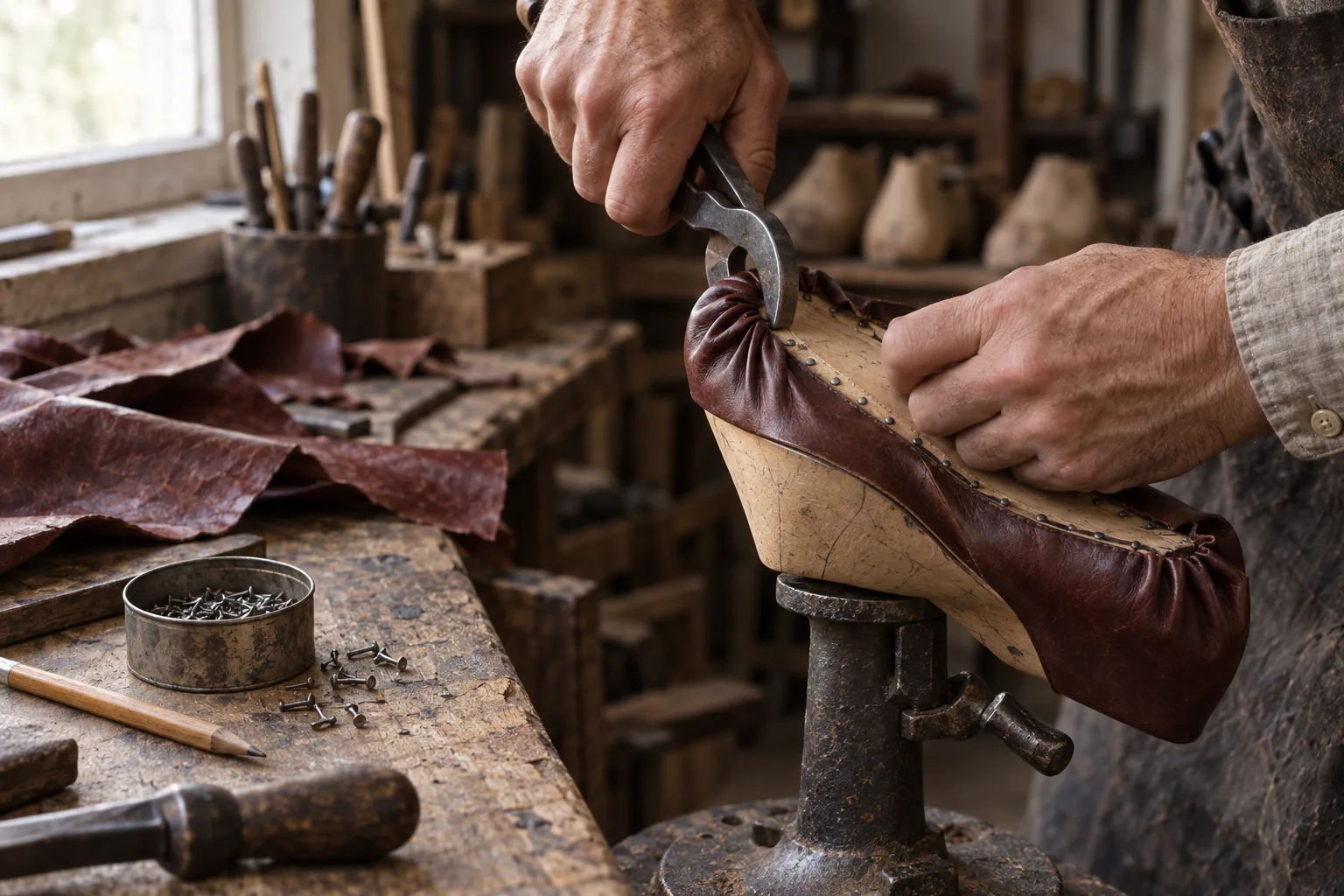
Lasted.
The upper pulled over the last and held with tacks while it sets.
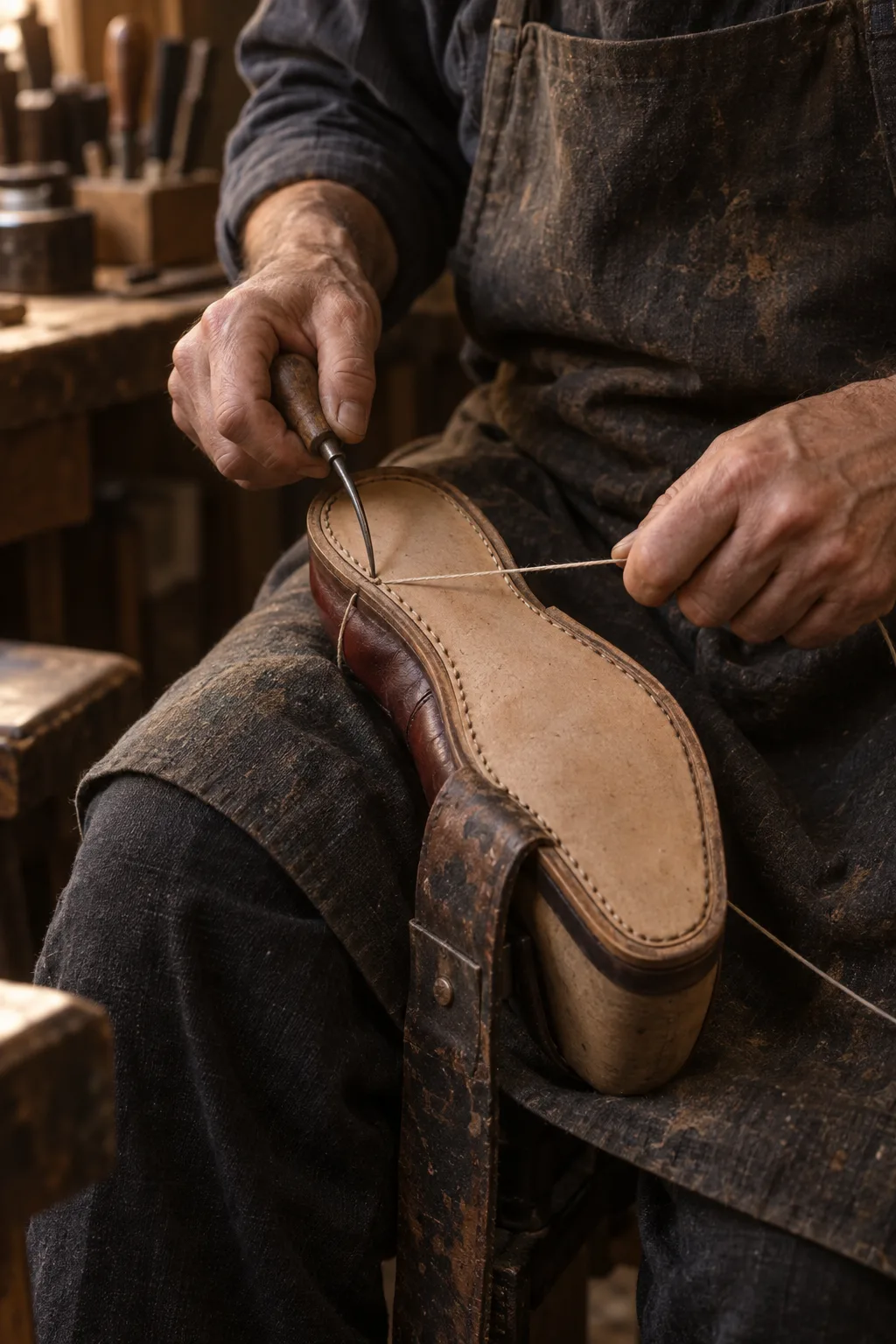
Welted and soled.
A welt sewn round, then the sole sewn to it through a channel you’ll never see.
Finished, and rested.
Edges set, polished, and left on the last a few days to keep its shape.
The first wear.
Wear them for a few weeks, then bring them back and we’ll see how they’ve settled.


The toe cap
Brogueing is a choice, made at the fitting: a plain cap, a straight cap with a line of punching, a medallion on its own, or the lot. Every hole is punched by hand with a set of three punches.
punched by hand, one hole at a time
The pattern you punched on the lasts at the top, close to. Look at the small holes: the right cap never falls hole for hole with the left.
Leathers, plainly
and what goes under them
For the uppers
- Box calf Smooth and close-grained; takes a high shine and creases fine.
- Waxed calf Oil and wax worked right through. It marks, then polishes back.
- Suede calf The flesh side, brushed. Soft, and wants a brush rather than polish.
- Goat A pebbled grain, hard-wearing and forgiving of scuffs.
- Kid Fine and light, for dress shoes.
Under your foot
- Bark-tanned sole leather Tanned slowly, firm underfoot, and wears in to you.
- Rubber A full rubber sole, or a thin half-sole over the leather, for wet winters.
- Calf and kid linings Smooth against a sock.
- The fiddleback waist The sole pinched in and shaped under the arch, with a ridge down the middle like the back of a fiddle. It’s the detail we took our name from.

Worn through
Old soles tell us how you walk: one side nearly always wears more than the other, and we build that back in. We take any good shoe with a sewn sole, ours or another maker’s.
and walking again
- Full resoles on a welted or sewn shoe
- New heels and top pieces
- Toe tips
- Re-welting
- Resewing a split seam
- A proper clean and polish
If a shoe can’t be resoled well, we’ll tell you before we start.
Two shoes
made one foot at a time
The left, a touch longer.
The right, a touch fuller at the ball.
Come in to be measured
A first measuring takes about an hour. Bring the shoes you wear most, and the socks you’d wear with the new pair. We’ll talk about what the shoes are for, and trace both feet.
For a resole or a repair, bring the shoes in and we’ll look them over with you before anything is taken off.
or bring a pair to mend