01T+00:00Lift-off
Cue 01 · Lift-off · 1:11 to write the name
Asterism: drone light shows, written cue by cue.
We design and fly choreographed drone light shows for festivals, openings and celebrations, from Adelaide. A show is a list of cues: a shape in the sky, the moment it arrives, the way each light flies to get there. This page is written as one. Scroll, and the lights follow.
Overhead, when this page’s script runs: the lights leave their grid on the ground and write our name.
02T+01:21Globe
A show is a list of cues.
Overhead: the lights gather into a sphere and turn, once every twenty-four seconds.
Before a light leaves the ground, the whole show already exists as a list. Each line is a cue: its number, the moment it begins, the shape the lights will make, and how long they hold it, long enough for people to point and turn to each other.
Between one line and the next, every light is given its own route, and none of them swaps places in the dark.
04T+03:32Flower59 m12 s
- Number the order, nothing more.
- In when the lights begin to move.
- Formation what the crowd will see.
- Route the path each light takes; the longest one sets the pace.
- Hold how long a shape stays up.

The globe is round. Use the arrow keys on the sky control, or the orbit buttons, to walk a little way round it.
03T+02:33Flock
Between two shapes, the flight is the show.
Overhead: every light is on, moving as one flock in three ribbons that fold, thin and never quite settle.
People remember the shapes; what they watch is the moves.
When a formation lets go, every light already knows where it is going and which way it will fly. The routes are planned so that lights passing each other keep to different heights, and they all arrive together.
That is why a change looks like a flock turning, not one picture fading into the next.
Pick a light and follow it: it is the same light that left the ground at the start, and it will be the same one that comes home at the end.
Follow one light
Or click any light in the open sky.
04T+03:32Flower
Made for the nights people gather.
Overhead: a flower of eight petals, opening slowly from the centre.
| Occasion | What the sky might hold | Try it |
|---|---|---|
| Eid | A crescent, then lanterns lifting | |
| Diwali | A row of lamps, lit one by one | |
| Lunar New Year | A lantern that rises | |
| New Year | A clock face turning to twelve | |
| Weddings | Two rings, then two initials | |
| Festival openings | A ribbon, drawn across the sky | |
| A building’s opening | The outline of its doorway | |
| Civic celebrations | The city’s own outline |
Each shape holds for a moment, then the flower comes back.
We fly shapes, words and moments, not advertisements: there are no sponsors’ marks in our skies.
Tell us what the night means and we will find its shape.
05T+04:31Skyline
Drawn for the place, and for the people in it.
Overhead: the outline of a city, invented for this page, its windows lit row by row.
A show is drawn for where people will stand. A shape that reads cleanly from the front can smear from the side, so every cue is checked from the edges and the back of the crowd as well as the middle.
Slow moves feel bigger in the sky than fast ones.
We plan around the place: the open sky above it, what people look past, where the lights can take off and land, which way the evening breeze tends to come from, and the music or the silence the cues are set to.
Then there is the quiet between two cues, when every head tilts up at once.
- where people stand
- where the show flies
- what is behind it

06T+05:36Your cue
Write a cue of your own.
Overhead: a lantern, in cool light, until you write a cue of your own.
Draw on the pad, type a short word, or choose a shape. The lights will leave the last cue and fly yours, and this page works out what it took.
Draw with a finger, a pen or a mouse. On a keyboard: arrow keys move the pen one dot, Space puts it down or lifts it, Enter flies your shape, Backspace takes back a stroke.
A shape can use up to 1,200 lights.
Or choose a shape
- Lights used
- – – of – –
- Longest route
- – –m
- Move at 3 m/s
- – –s
- Standing by
- – –
Worked out on this page from the routes you just watched, for a model sky 160 metres across with no light faster than 3 metres a second. An illustration, not a flight plan.
Your shape is flown here and nowhere else. Nothing is kept or sent.
07T+06:49Storyboard
From a sentence to a sky.
Overhead: four small frames, two by two, each an earlier cue in miniature: this page’s own storyboard.
1The brief
It starts with the night itself: the occasion, the place and the moment it is for. Who will be looking up, from where, and what should they feel when the first light lifts?
2The storyboard
We draw the shapes in order, as dots on paper, and set them to the music or the silence. Every cue is given its moment, its hold and the move that leads into it.
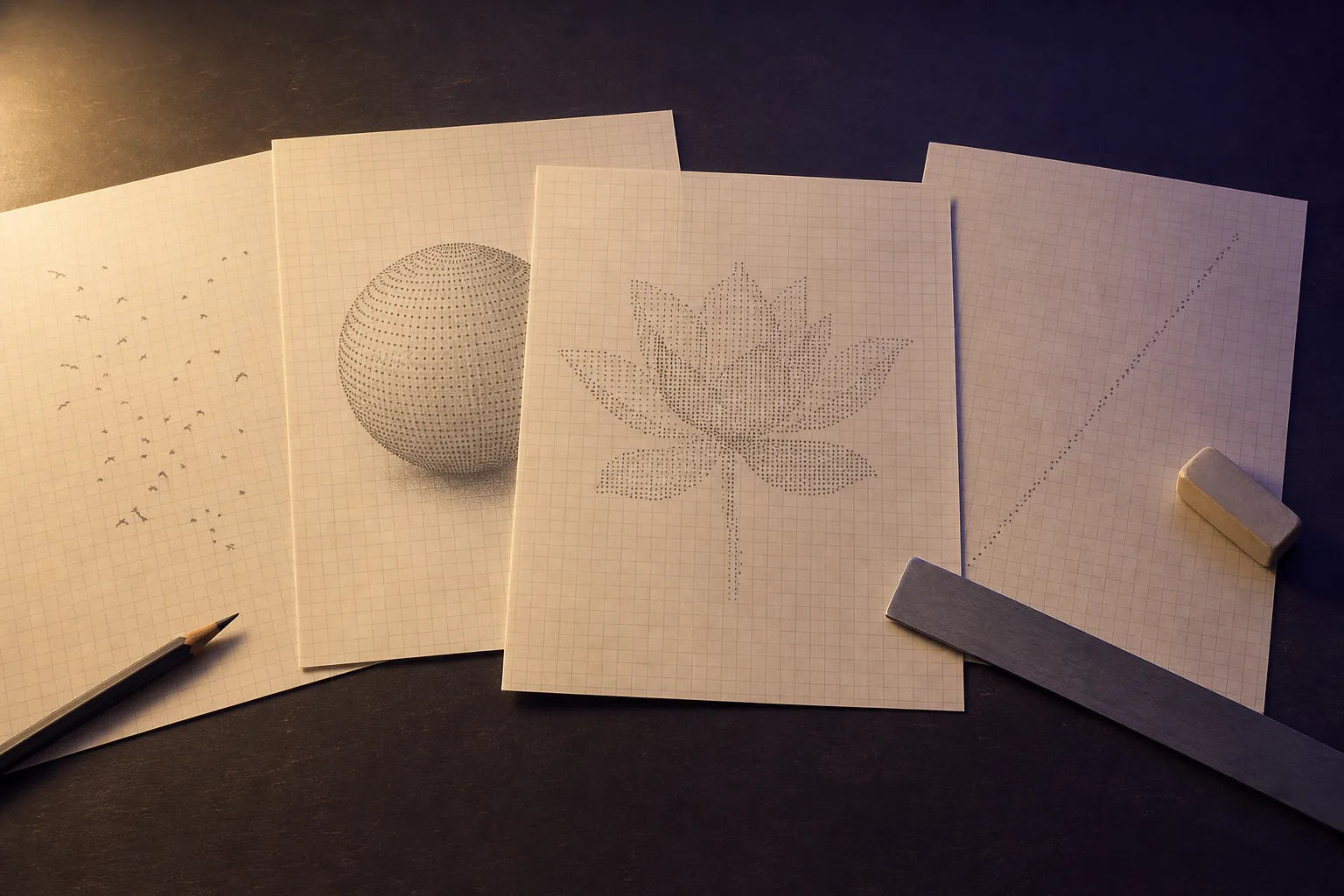
The shapes, in order, before any of them fly. 3The preview
Then the whole show is flown on screen first, much like this page, so you can see every cue, every move and every pause from where your guests will stand, well before the night.
4The night
Before dark the crew lays the lights out in rows on the ground, each one in its place. On the first cue they lift, and the list on paper becomes the sky over everyone’s heads.
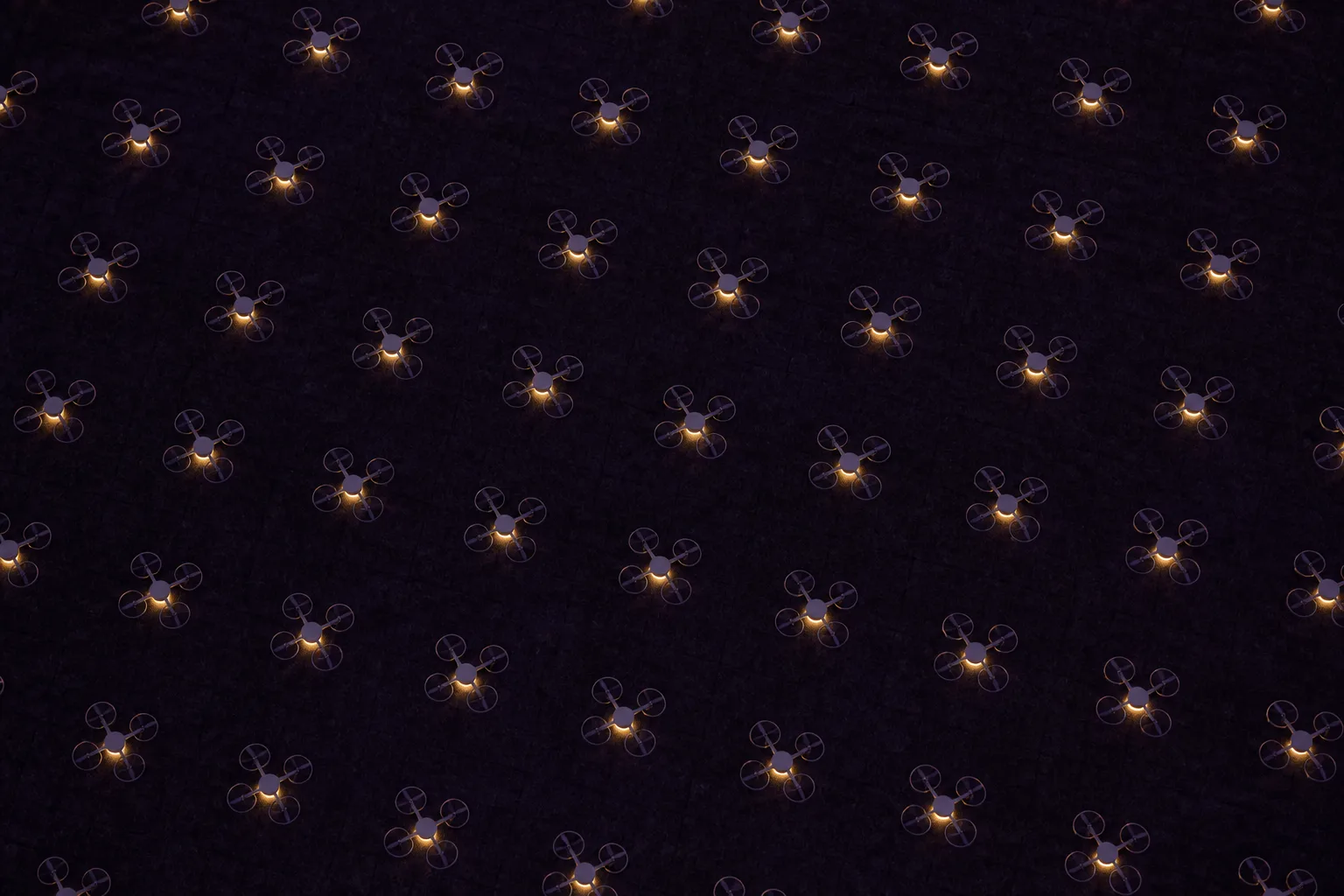
Before dark: the lights in their rows, waiting for the first cue. 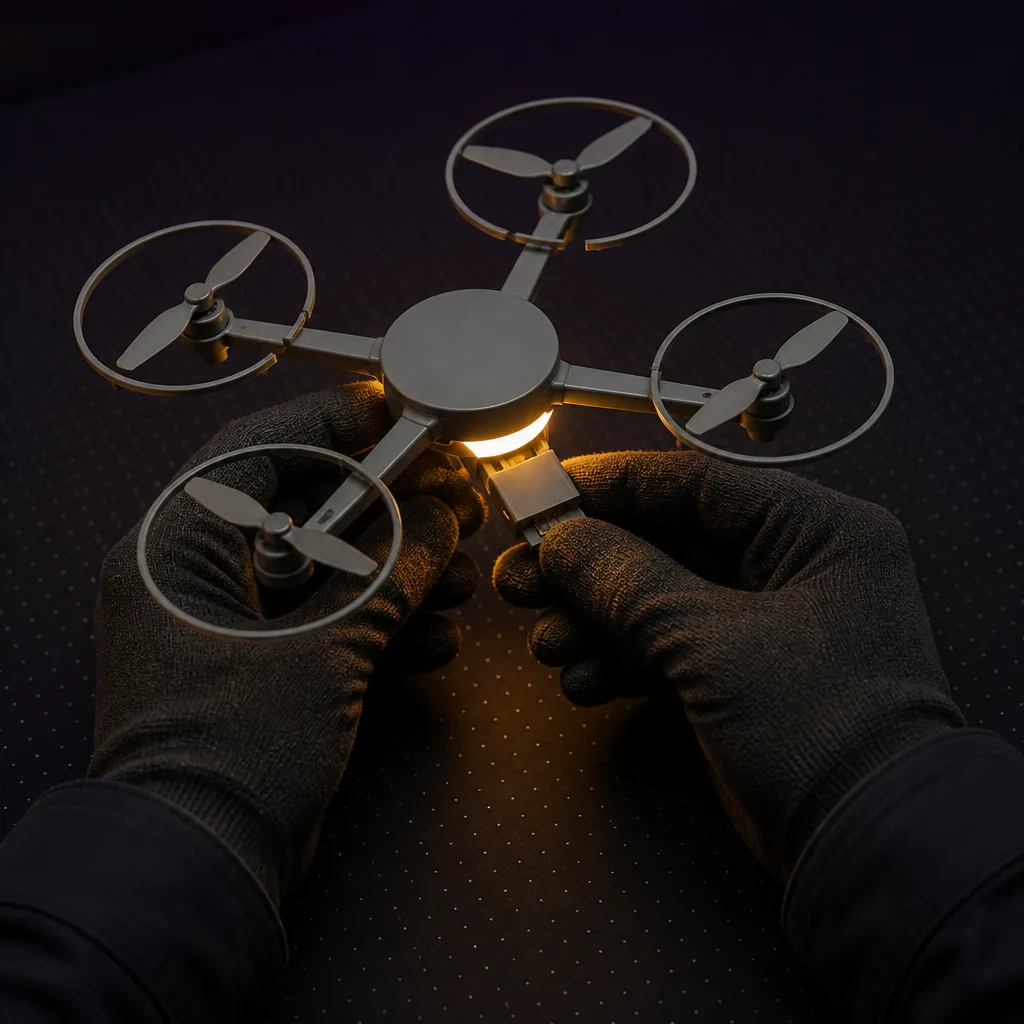


08T+07:52One line
The running order.
Overhead: every light in one level line across the sky, dimming from the ends inwards.
| Cue | In | Formation | Lights lit | Longest route | Move | Hold |
|---|---|---|---|---|---|---|
| 01 | 00:00 | The name | 2,299 | 87 m | 1:11 | 10 s |
| 02 | 01:21 | Globe | 2,458 | 74 m | 1:00 | 12 s |
| 03 | 02:33 | Flock | 4,096 | 55 m | 45 s | 14 s |
| 04 | 03:32 | Flower | 2,457 | 59 m | 48 s | 12 s |
| 05 | 04:31 | Skyline | 2,215 | 67 m | 55 s | 10 s |
| 06 | 05:36 | A lantern | 925 | 77 m | 1:03 | 10 s |
| 07 | 06:49 | Storyboard | 2,093 | 65 m | 53 s | 10 s |
| 08 | 07:52 | One line | 4,096 | 106 m | 1:26 | 8 s |
| 09 | 09:26 | One light | 1 | 59 m | 48 s | 8 s |
| 10 | 10:22 | The landing | 0 | 82 m | 1:06 | – |
Worked out on this page for a model sky 160 metres across, with no light flying faster than 3 metres a second. An illustration of how a show is timed, not a flight plan: a real show is planned on its own site, for its own night. These figures were worked out when this page was made, for 4,096 lights. Total run time 11:28.
The show ribbon: every move and hold, in proportion. On screen each move is sped up to a few seconds.
09T+09:26One light
Tell us about the night.
Overhead: the line draws in to a single light, held still, in no hurry.
The last cue is the quiet one. The lights draw in to a single point and hold, and nobody is in a hurry to leave. The best nights end with people still looking up after the lights have gone.