

A hundred and twenty. The medallion’s edge starts to curve, and you can still see the wool.
A small sampler, tied from the bottom up the way a loom works. Knot counts here are illustrative.
Tied one knot at a time.
Hand-knotted rugs in Norwood: new pieces from workshops in Iran, Afghanistan, Türkiye, India and Nepal, and older rugs chosen one at a time. Borrow one for a week and see it in your own light.
This is the pile. Every tuft is a knot, tied round two warps and clipped.
Run your hand against the pile: it goes darker, as a rug does.
Why the colour shifts.
Look along a rug from one end and the red changes about a third of the way up. That’s abrash, and it’s where our name comes from. Wool is dyed in small pots, no two alike; when one batch runs out the weaver carries on with the next, and the join stays ragged because each knot picks up the new wool in its own row.
We look for it: a rug without any tends to read flatter on the floor. The bands behind these words are drawn from the joins in the rug you tied above.
The red changes a third of the way up. That’s the part we look for.
On the floor now.
Older rugs come in one at a time, chosen for their drawing, their colour and honest wear. We’ll show you every repair.
-
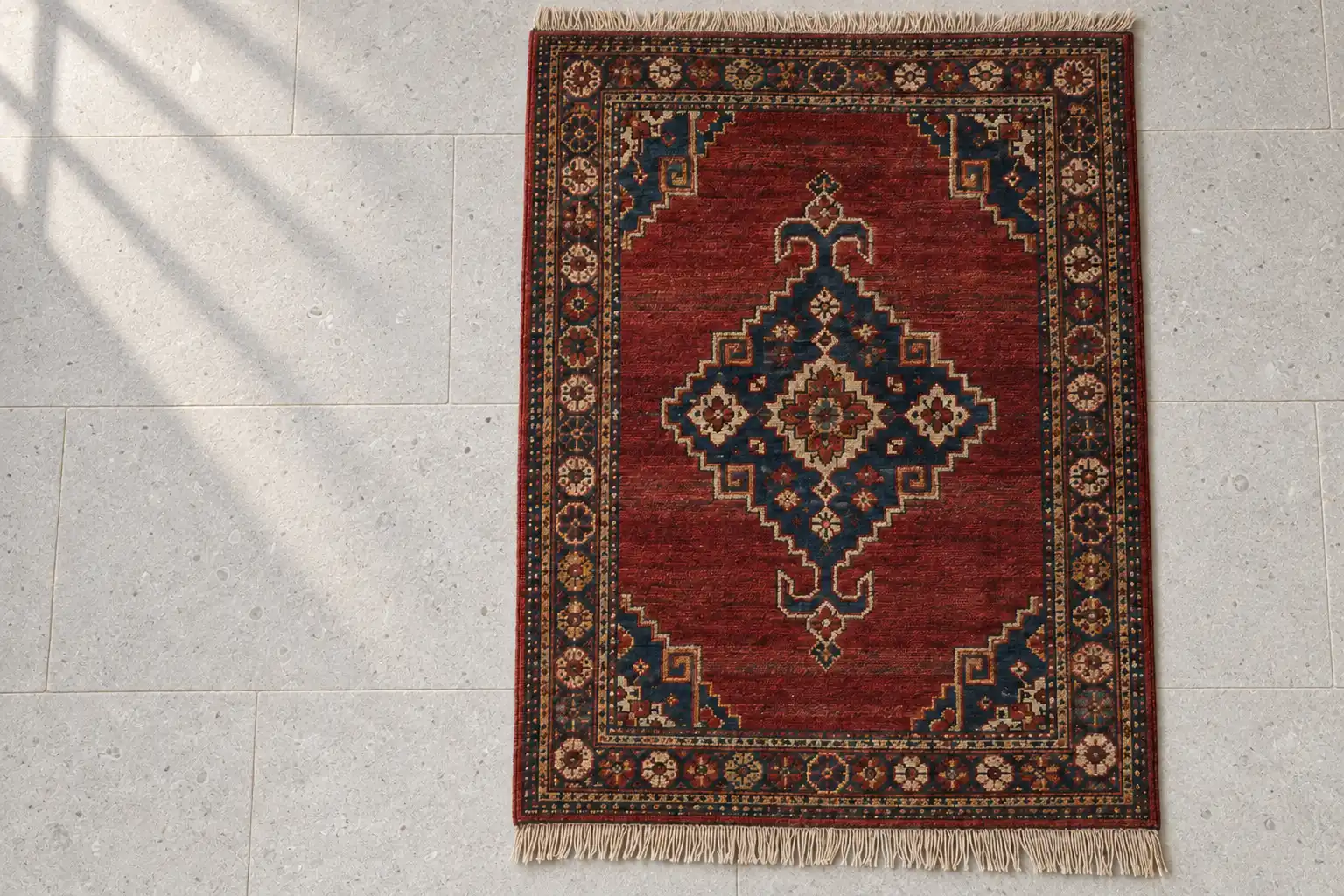
Madder field, medallion and corners
- Woven in
- Iran
- Knot
- Asymmetrical
- Knots per sq in
- 120 (illustrative)
- Size
- 200 × 250 cm
- Wool and dyes
- Hand-spun wool; madder, indigo, walnut
- Pile
- 8 mm
Tied in a workshop that dyes its own madder, so the red moves in long, soft bands. The border turns each corner on a whole rosette.
Borrow this one for a week -
Rows of octagons
- Woven in
- Afghanistan
- Knot
- Asymmetrical
- Knots per sq in
- 100 (illustrative)
- Size
- 160 × 230 cm
- Wool and dyes
- Hand-spun wool; madder, indigo
- Pile
- 9 mm
A madder ground with rows of quartered octagons you can read from across a room. The wool is a little uneven, so the pile catches the light.
Borrow this one for a week -
Stepped medallion
- Woven in
- Türkiye
- Knot
- Symmetrical
- Knots per sq in
- 60 (illustrative)
- Size
- 170 × 240 cm
- Wool and dyes
- Wool; madder, weld, walnut
- Pile
- 10 mm
Every edge is a step, which is how the symmetrical knot draws best. A springy pile that suits a hall or a room people walk through.
Borrow this one for a week -
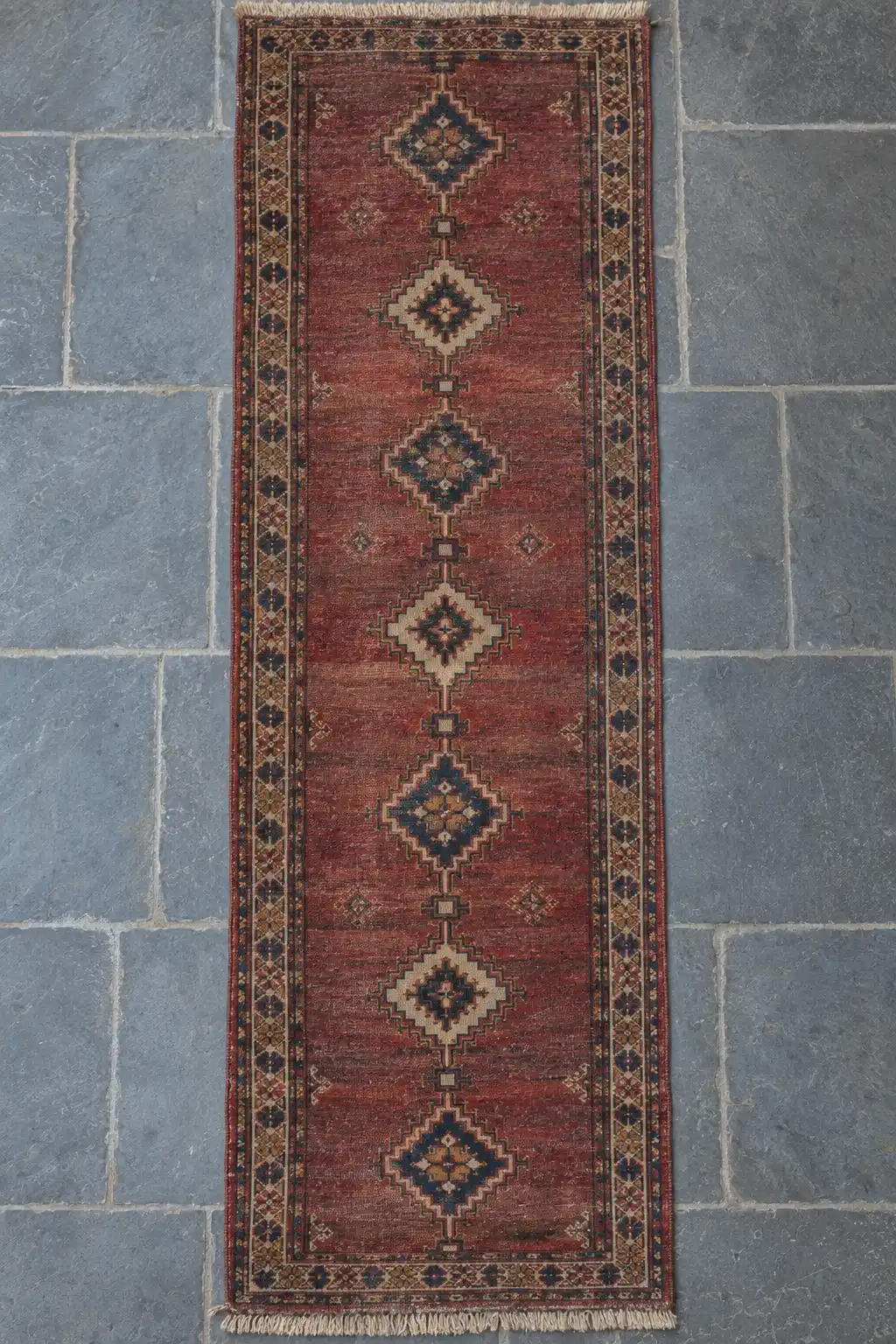
An older runner, faded madder
- Woven in
- Iran
- Knot
- Asymmetrical
- Kind
- An older piece
- Size
- 90 × 280 cm
- Wool and dyes
- Wool; madder, indigo, softened with wear
- Pile
- Low, worn
Worn low in the middle where it was walked on; we’ve overcast one side and left the wear honest. A column of small lozenges runs its whole length.
Borrow this one for a week -
Soft lattice of rosettes
- Woven in
- India
- Knot
- Asymmetrical
- Knots per sq in
- 200 (illustrative)
- Size
- 250 × 350 cm
- Wool and dyes
- Fine wool; soft madder, indigo
- Pile
- 7 mm
A count this fine lets the lattice curve. Softer colour, for a big, quiet room.
Borrow this one for a week -
Plain field, abrash in blue
- Woven in
- Nepal
- Knot
- Tibetan
- Knots per sq in
- 100 (illustrative)
- Size
- 180 × 270 cm
- Wool and dyes
- Hand-carded highland wool; indigo
- Pile
- 12 mm
Nothing on the field but the indigo changing from batch to batch, and that is the whole design. Long and soft underfoot.
Borrow this one for a week

Rugs 2, 3, 5 and 6 are drawn for this page from a knot chart; come in to see this week’s pile.

Start with the back.
The back of a hand-knotted rug is its honest side: every knot shows there as a small square of colour, and you can see how finely it was tied and how evenly the rows were beaten down.
Turn it end to end and look along it. The colour moves in bands where one batch of wool gave way to the next, and on the back those bands read plainly, row by row.
Then the ends and sides. The fringe is the warp itself, carried through the whole rug. If a fringe has been sewn on, we’ll tell you.
Reading a rug
Choose a word and we’ll show you where it is on the rug you tied.
- The shift in colour where one batch of dyed wool runs out and the next begins. It crosses the rug in bands, with ragged joins.
- The threads strung the length of the loom before any knot is tied. Every knot is tied round a pair of them.
- The threads passed across between each row of knots and beaten down. They lock the rows in place.
- The clipped ends of the knots, standing up as the surface you walk on. It leans one way, which is why a rug has a light end and a dark end.
- A short length of wool wrapped round two warps and cut. The count per square inch sets how fine the drawing can be.
- The long sides, where the outer warps are wrapped in wool. We re-overcast worn ones in wool dyed to match.
- The warp ends, knotted off where the weaving stops. It is part of the rug’s foundation, not an edging.
- The ground inside the borders. It holds a medallion, a repeat, or nothing but the colour of the wool.
Where they’re tied.
New rugs come to us from workshops in five countries. Each ties the knot its own way, and the knot shapes the drawing.
Iran
Mostly the asymmetrical knot, open to one side, so the drawing can curve. Fine wool, and fields that hold a large medallion.
Afghanistan
Hand-spun wool, madder grounds, bold rows of octagons you can read from across a room.
Türkiye
The symmetrical knot, both ends drawn up between the warps. Stepped drawing, clear colour.
India
Workshops in Uttar Pradesh and Rajasthan tie fine counts, in softer colour.
Nepal
The Tibetan knot, looped over a rod and cut, in hand-carded highland wool. Plain fields where abrash is the whole design.
From the loom to your floor.
This is the back of the rug you tied at the top of the page. A turned rug lies the other way up, so it starts at the top.
Dye pot
Batches of indigo or madder, never quite alike.
Spinning
By hand, a little uneven, so it catches the light.
Warping the loom
Warps strung the length of the rug; the fringe is their ends.
Knot by knot
A knot round each pair of warps, a row at a time from the bottom, weft beaten down between; a new batch means abrash.
Off the loom
Ends knotted, pile clipped level.
The wash
Washed flat in running water, stretched square, dried in the sun.
Our floor
In Norwood we lay it down and get to know it.
Your floor
A week at yours before you decide.

Sizes drawn to scale on this floor; illustrative. Drag the rug to place it, or use the arrow keys.
A week on your floor.
Choose up to three rugs, here or from the pile. We bring them to your place, lay them out, and leave them for a week. Live with them in your own light, morning and evening; we’ll collect the ones you don’t keep.
Around Adelaide; ask us about further out.
Ask to borrow
Washed and mended by hand.
- Washing by hand
- Dusted, washed flat in cool water, rinsed until it runs clear, dried flat.
- Re-knotting worn patches
- New knots in matched wool, tied into the old foundation, clipped to the height around them.
- Ends
- Loose ends secured and fringes rebuilt from the warp.
- Sides
- Selvedges re-overcast in wool dyed to match.
- Moth
- Treated, then the bare patches re-knotted.
- Evening the pile
- Clipped level by hand, a little at a time.
Looking after a rug
- Turn it end for end twice a year so it wears evenly.
- Vacuum along the pile, never with a rotating brush head.
- Blot spills; don’t rub.
- Keep it out of hard afternoon sun.
- Use an underlay on timber or stone.
Bring it in, or we’ll collect it.
Come in and turn a few back.
We’re in Norwood. Wednesday to Saturday, ten till five; Sunday afternoons. Bigger rooms and whole houses by arrangement.
Tell us about the room and the floor, and roughly how much space there is. If it’s a rug that needs washing or mending, say what you’ve noticed; we’ll look at the back before we say anything.